Playroom Storage Kids Can Actually Use
Toy storage fails when it is designed for adults. How to use open bins, picture labels, and a simple rotation so children can put things away themselves.
A playroom can be perfectly organized and still be unusable by the people it is for. The usual sign is a wall of lidded boxes at adult height, sorted by a system only an adult understands, with the toys themselves on the floor. Storage that children cannot operate is storage that adults maintain forever.
This post contains affiliate links. If you buy through them, we may earn a commission at no extra cost to you. Read our Affiliate Disclosure.
The fix is partly physical — lower, open, easier to use — and partly numerical. Most playrooms hold more than any child can manage, and the surplus is what makes tidying a fight.
Design for the height of the user
The working zone for a three-year-old is roughly the bottom two feet of the room. For a six-year-old it is closer to three feet. Anything above that is adult storage, which is fine, but it should hold the out-of-season and the grown-up things, not the toys in daily use.
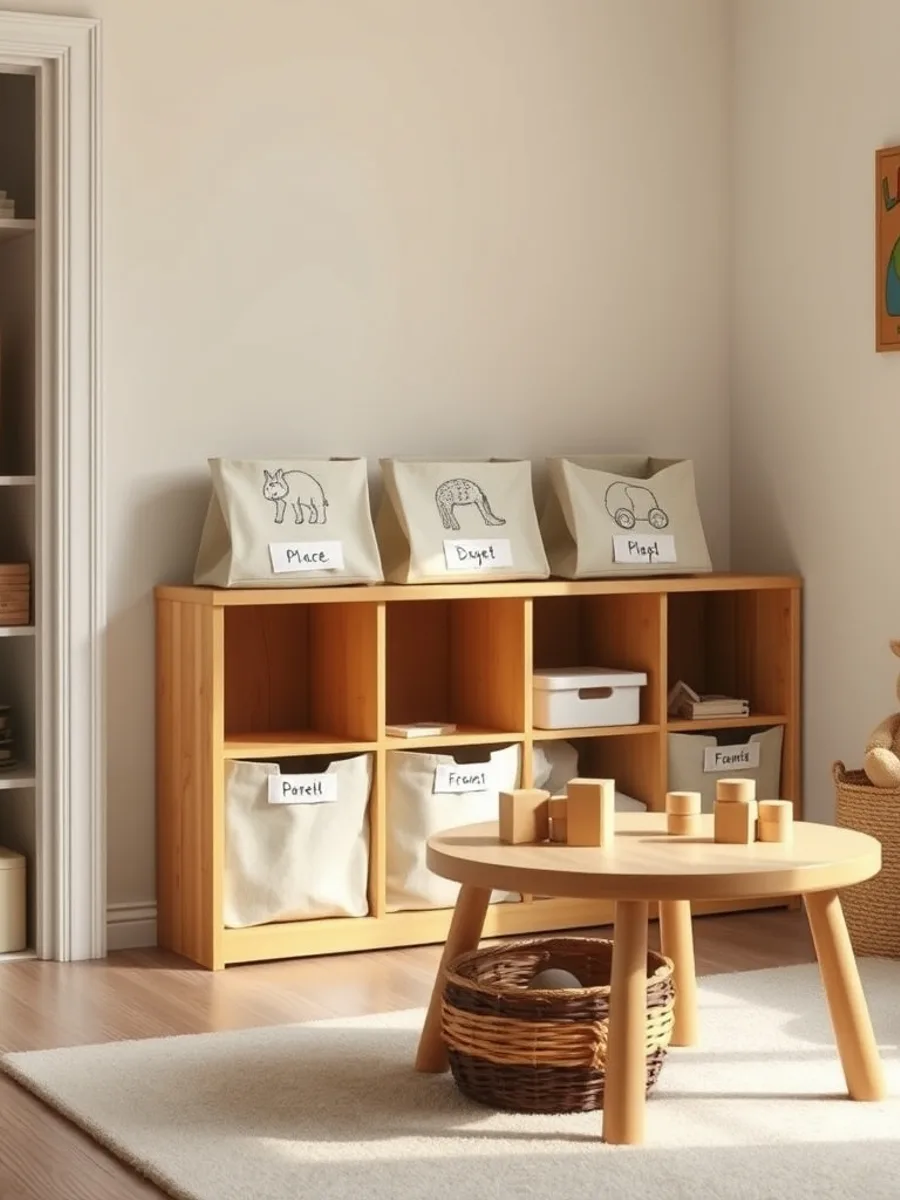
Open bins beat lidded boxes at every age, because the act of putting something away has to be easier than dropping it. A lid is a barrier; a latch is a barrier with a puzzle attached. If a bin is too heavy for a child to pull out and carry, it will be emptied where it stands and never refilled.
Labels matter, but only the right kind. Words do nothing for a pre-reader. A photo or a simple drawing of what belongs in the bin — cars, blocks, animals — lets a child sort without help. Tape them on the front at child height, and replace them when the contents change, because a label that lies teaches children to ignore labels.
Fewer things, in rotation
The most effective storage decision is not a product. It is keeping less out at once. Children play longer with fewer toys, and they tidy up faster, because the volume is manageable and the choices are visible.
A rotation works like a library. Keep two-thirds of the toys in closed storage somewhere else — a closet shelf, a labeled bin in the garage, under a bed — and swap the contents every few weeks. The toys that come back feel new, and the ones that are never asked for are the ones to pass on. If a toy has been in the swap box for two rotations without being requested, it can leave.
One category per bin
Mixed bins become an archaeology project: everything gets dumped in, nothing gets found, and the bin becomes a source of conflict rather than play. Give each bin one category, and keep the categories broad enough for a child to apply — "cars", "blocks", "animals", "art" — rather than the fine-grained sorting adults like.
Small parts deserve their own container with a lid, kept out of reach of children under three. That is a safety decision, not a storage preference.
Containers that survive a child
| Product | Best for | What to know |
|---|---|---|
| Open canvas storage bins | Everyday toys a child can reach | Check the handle and that the bin slides easily on the shelf |
| Low cubby shelf | A tidy base for bins at child height | Measure the cubby opening against the bins you plan to use |
| Picture label stickers | Pre-readers sorting their own things | Choose images of the actual toys, or draw them together |
| Stackable bins with latches | The rotation, stored out of the room | Latches are adult-proof by design, which is the point here |
| Woven floor basket | Balls, dress-up clothes, soft toys | A wide mouth and a light weight matter more than the look |
Skip anything with a lid a child cannot open, and skip deep toy chests with a hinged lid — they hide everything at the bottom and the lid is a hazard for small hands. A shallow open tray at floor level works better than a chest every time.
The reset that takes ten minutes
Tidying a playroom is not the same as cleaning it. The ten-minute version, done at the end of the day, is enough to keep the system alive: everything back in its category bin, the floor clear, the art on the wall rather than underfoot.
Two rules keep it from becoming an adult job. First, the child does the putting away, with help rather than instead. Second, if something does not fit in its bin, the bin is full, and something has to leave — which is the same keep rule that works in a closet.
If the playroom shares space with the living room, the containment has to be stricter. A single cubby unit with a closed back, or a low cabinet that closes, lets the room return to adult use in the evening. The same principle applies in closet organization, where the visible surface has to be clear for the space to feel calm. Bins that suit small hands are matched in storage baskets, and overflow that has to live out of sight fits the containers in under-bed storage.
FAQ
At what age can children use open bins?
From around eighteen months, with help. A toddler can drop a toy into a low open bin long before they can open a latch or read a label, which is why open, low storage is the right starting point and stays useful until around seven.
How many toys should be out at once?
Enough to fill the accessible bins, and no more. Many households find that a third of the collection out at a time is plenty; the rest goes into rotation, which keeps the room manageable and makes the toys that return feel new.
How do you label toy bins for children who cannot read?
Use a photo or a simple drawing of the contents, taped to the front of the bin at the child's eye level. Take the photo with the actual toys in it, print it small, and replace it when the contents change so the label keeps meaning something.